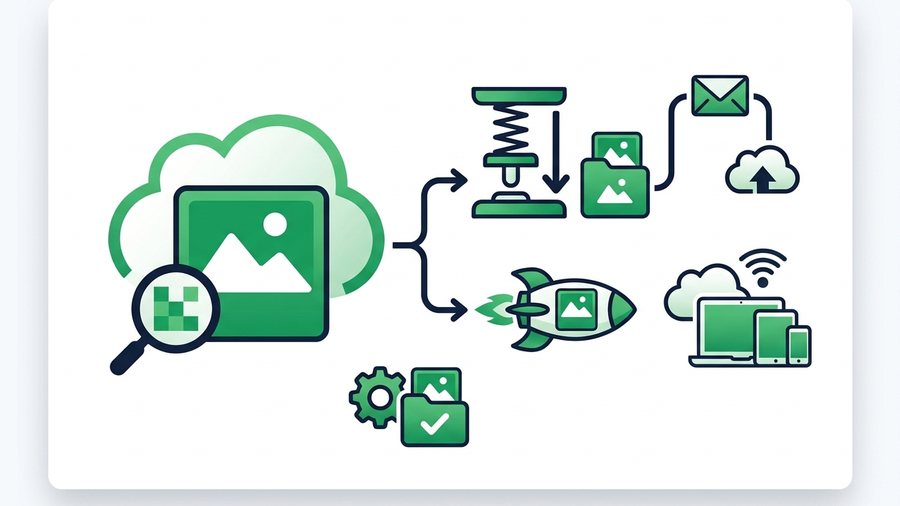
You snapped a batch of photos, went to email them, and hit a wall. The files were too big, the upload crawled, and your friend never got them. If that sounds familiar, you are not alone. JPG photos from modern phones and cameras can easily run 5 to 15 MB each, and a handful of them will blow past most email limits.
The good news is that JPGs are flexible. You can shrink them down for quick sharing, or send them full-size when quality matters. This guide walks through why JPGs get so big, how to pick the right approach, and how to hand off your photos in a few clicks.
By the end, you will know exactly when to compress, how to do it in under a minute, and how to share the result with a clean link that anyone can open.
Key takeaways
- JPGs from modern phones run 5 to 15 MB each, and a 48MP shot can weigh 20 MB or more.
- Compressing to around 80% quality trims 60 to 80% of the size with no visible loss.
- Lossy compression removes data for good; lossless keeps every pixel but barely shrinks photos.
- Even 100 photos at 48MP, roughly 1.5 to 2 GB, fit inside ShareIt.onl's free 3 GB, 100-file link.
Why JPG Files Get So Big
Two things drive the size of a JPG: how many pixels it holds and how much detail the camera keeps. More of either means a bigger file.
Megapixels Add Up Fast
Every photo is a grid of tiny dots called pixels. A 12-megapixel photo has about 12 million of them. A 48-megapixel photo has four times as many. Each pixel needs data to store its color, so doubling the resolution roughly doubles or quadruples the file size before any other factor kicks in.
Phones now ship with 48MP and even 200MP sensors. Those numbers look great on a spec sheet, but they also mean a single image can weigh 20 MB or more if you shoot at full resolution.
Tip: Shoot the same scene twice, once busy and once plain, and compare the file sizes. A photo packed with texture like leaves or gravel compresses far less than a flat wall or clear sky, so your "typical" JPG size shifts a lot with the subject.
The Quality Setting Matters
JPG uses a quality slider, usually from 1 to 100. A setting near 100 keeps almost every detail and makes a large file. A setting around 70 to 80 throws away detail your eye can barely see and cuts the size in half or more. Most cameras default to a high setting, which is why straight-off-the-camera JPGs are so heavy.
Typical JPG Sizes by Camera
Here is a rough guide to what you can expect. Actual sizes shift with the subject, since busy scenes with lots of texture compress less than plain ones.
| Camera resolution | Typical dimensions | High-quality JPG | Compressed JPG (~80%) |
|---|---|---|---|
| 12 MP | 4032 x 3024 | 4 to 6 MB | 1.5 to 2.5 MB |
| 24 MP | 6000 x 4000 | 8 to 12 MB | 3 to 5 MB |
| 48 MP | 8000 x 6000 | 15 to 25 MB | 5 to 9 MB |
As you can see, moving from a 12MP phone to a 48MP one can quadruple your file size. Ten 48MP photos can easily total 200 MB, which blows far past any email attachment limit - though even a hundred of them, around 1.5 to 2 GB, still fit in one free ShareIt.onl share.
Lossy vs Lossless: What Compression Really Does
Not all compression works the same way, and knowing the difference helps you choose wisely.
- Lossy compression removes some image data permanently to shrink the file. JPG itself is a lossy format. Done gently, the loss is invisible. Pushed too hard, you get blocky patches and fuzzy edges.
- Lossless compression shrinks the file without throwing away any data, so the image is identical to the original. Formats like PNG use it, but the size savings on photos are much smaller.
For everyday photo sharing, smart lossy compression is the winner. It can cut a file by 60 to 80 percent while keeping the picture looking sharp on any screen. Save lossless only for images you plan to edit heavily or print at large sizes.
When to Compress vs Send the Original
You do not always need to compress. Match your choice to how the photo will be used.
Compress When...
- You are sharing for viewing on phones, tablets, or laptops.
- You are sending many photos at once and want a fast upload.
- The recipient has slow internet or a data cap.
- The photos are going into a text, chat, or social post.
Send the Original When...
- A photographer or client needs the full-resolution file.
- The image will be printed larger than 8 by 10 inches.
- Someone will crop in tightly or do serious editing.
- You are archiving the shot for the long term.
A simple rule: if the photo is meant to be looked at, compress it. If it is meant to be worked on, send it full-size.
How to Compress a JPG in Under a Minute
You do not need photo-editing software to shrink a JPG. A free tool like jpg.now's JPG compressor does it right in your browser, with no install and no watermark. Here is the flow:
- Open the compressor in any browser.
- Drop in your JPG files, one or several at a time.
- Let the tool apply smart compression, usually landing near 80 percent quality.
- Preview the result to make sure it still looks crisp.
- Download the smaller files to your device.
Most photos come out looking identical at a fraction of the size. If you want an even deeper walkthrough of settings and trade-offs, our guide on how to compress files before sharing covers it step by step.
If your originals are enormous and you would rather not compress at all, you can also just send high-resolution photos as-is with a link, which we cover below.
Then Share Your JPGs With a Link
Once your files are the right size, you need to actually get them to someone. Email limits, usually 20 to 25 MB, make attachments a poor choice for photo batches. A link is far more reliable.
With ShareIt.onl you can drop up to 100 files, totaling 3 GB, into your browser and get a share link right away. No sign-up, no app - one big file or up to 100 files that together total 3 GB. Whether you compressed your JPGs down to a few megabytes each or kept them full-size, the process is the same: upload, copy the link, and send it.
What You Get With a Link
| Feature | Why it helps |
|---|---|
| Expiring link | Public access ends on schedule; stored files remain private in My Files |
| QR code | The recipient scans and downloads on a phone in seconds |
| Optional password | You control who can open the files |
| No account | Both sides skip the sign-up hassle |
Because a link sidesteps attachment limits entirely, it works just as well for a single 20 MB original as it does for a hundred compressed shots. For a broader look at moving big batches, see our guide on sending large files online.
Your Quick JPG Sharing Checklist
Run through this before you hit send:
Working with iPhone photos instead? Many of them are saved as HEIC, not JPG, which brings its own quirks. See our companion guide on how to share large HEIC files for the details.