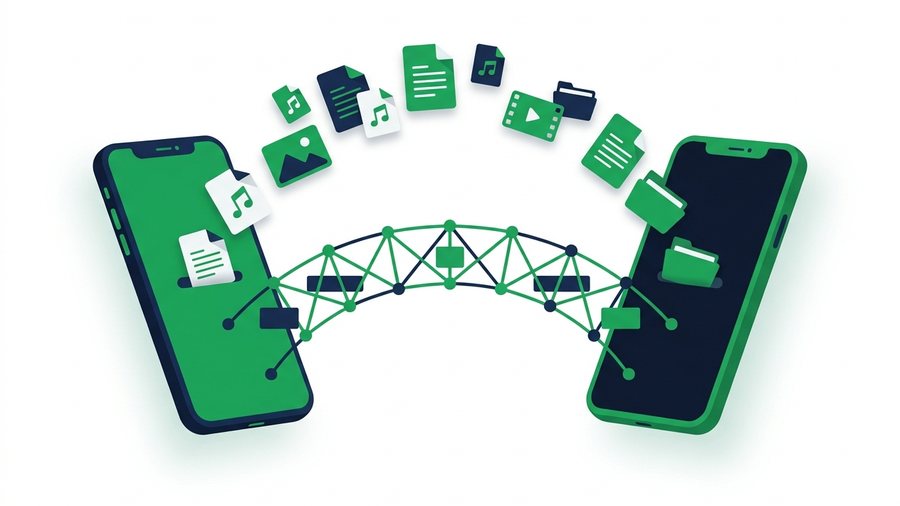
You're holding an iPhone. Your friend is holding a Samsung. You both want the same 30 photos from tonight, and suddenly two of the most advanced phones on Earth can't figure out how to talk to each other.
This isn't your fault. Apple and Google each built excellent sharing tools - AirDrop and Quick Share - And then made sure they only work inside their own walls. AirDrop needs an Apple device on both ends. Quick Share needs Android (or Windows). Point one at the other and nothing happens.
The fix isn't a special app both people have to install. It's simpler than that: use the one thing both phones already share - A web browser. Here's what actually works, what quietly ruins your photos, and how to move files across the Android–iPhone gap in under a minute.
Key takeaways
- AirDrop needs an Apple device on both ends; Quick Share needs Android or Windows - Neither crosses the line.
- WhatsApp compresses photos to about 70% quality and caps the long side near 1600–2048 pixels.
- SMS/MMS between the two platforms can crush a video to just 1–3 MB.
- A browser share link moves up to 100 files / 3 GB at full quality, with no app or account on either side.
Why AirDrop and Quick Share Don't Cross Over
AirDrop uses Apple's own handshake protocol (AWDL) over Bluetooth and Wi-Fi. Quick Share uses Google's equivalent. They're similar ideas - Nearby device discovery plus a fast direct connection - But they speak different languages and neither company supports the other's standard.
So when you tap Share on an iPhone, Android phones simply never appear in the AirDrop list, and vice versa. There is no setting to fix this. Any method that works has to route around the platforms entirely.
The Chat-App Trap: Free Transfers That Cost You Quality
Most people fall back to WhatsApp, Messenger, or plain text messages. It works - But the file that arrives is not the file you sent.
- WhatsApp compresses photos to roughly 70% quality and caps their longest side around 1600–2048 pixels. A 12 MP photo (about 4000×3000) arrives at a fraction of its detail. Videos get crunched hard too.
- Instagram and Messenger DMs recompress images and strip metadata like location and capture date.
- SMS/MMS between Android and iPhone is the worst offender: carriers often squash videos to around 1–3 MB, turning a crisp clip into a blurry postage stamp. RCS support (rolling out since iOS 18) improves this, but quality still isn't guaranteed on every carrier.
- Email keeps full quality but usually caps attachments at 20–25 MB - One minute of 4K video already blows past that.
If the photos matter - A trip, a wedding, a newborn - Chat apps are how memories get quietly degraded. For video specifically, see our guide to the best way to share large videos.
Warning: Green-bubble texting between an iPhone and an Android phone falls back to MMS, which can squash a clip to 1–3 MB. Never use it for photos or video you want to keep at full quality.
The Universal Bridge: A Browser Share Link
Every Android phone and every iPhone ships with a browser. That makes a temporary share link the true cross-platform method - No app installs, no accounts, no compression.
The Browser Link Flow
Here's the flow with ShareIt.onl:
- On the sending phone, open the browser and go to the upload page.
- Select your files - Up to 100 files or 3 GB total in one transfer. Original quality is preserved; nothing gets recompressed.
- Pick an expiry: 1 hour, 12 hours, 24 hours, 3 days, or 7 days - or 30 days with a free sign-in.
- Upload. You get a short link and a QR code.
- Send the link any way you like (even through WhatsApp - Links don't get compressed, only media does), or let the other person scan the QR code.
- They tap the link and download the originals. When the timer expires, the files are deleted.
The same trick works for moving files from your phone to a computer - Any device with a browser can be on either end. It is just as handy for transferring files between two phones of any brand.
The QR Scan Flow: Fastest When You're Face to Face
If the other person is standing next to you, skip sending the link at all:
- Upload your files and let the QR code appear on your screen.
- Your friend opens their camera app - Both iPhone and modern Android phones scan QR codes natively, no scanner app needed.
- They point the camera at your screen, tap the banner that pops up, and land straight on the download page.
Total time from "want these photos?" to downloading: about 30 seconds. Our QR code sharing guide covers this in more depth, including tips for reliable scanning.
Method Comparison: What Survives the Trip?
| Method | Works Android ↔ iPhone? | Quality Loss? | Practical Size Limit |
|---|---|---|---|
| AirDrop | No | - | - |
| Quick Share | No | - | - |
| WhatsApp / Messenger | Yes | Yes, heavy on photos/videos | ~2 GB but compressed |
| SMS / MMS | Yes | Severe for video | ~1–3 MB |
| Email attachment | Yes | No | 20–25 MB |
| Cloud drive (Drive/iCloud) | Yes, with accounts | No | Free tier: 5–15 GB total |
| Browser share link | Yes | No | 3 GB per transfer |
Cloud drives deserve a mention: they preserve quality and cross platforms fine. The catch is that both people need accounts, the sender has to manage sharing permissions, and the files sit there forever until someone remembers to delete them. For a one-time handoff, that's overkill. If you'd like a start-to-finish example, our walkthrough on sharing between iPhone and Android runs through a real transfer step by step.
Quick Tips for a Smooth Cross-Platform Transfer
- One upload usually covers it. A 3 GB transfer holds up to 100 photos or roughly 8 minutes of 4K video, so a whole evening's shots fit in a single share. With phone photos, the 100-file count is the limit you'll hit first, not the size.
- Match the expiry to the situation. Handing photos to someone in the room? 1 hour is plenty. Sending to a relative who checks their phone weekly? Pick 7 days.
- Send the link, not the files, through chat apps. A link pasted into WhatsApp arrives untouched; the photos themselves would be compressed.
- iPhone HEIC files: most modern Android phones open HEIC fine, but if your recipient has trouble, set your iPhone camera to "Most Compatible" (JPEG) in Settings before shooting.